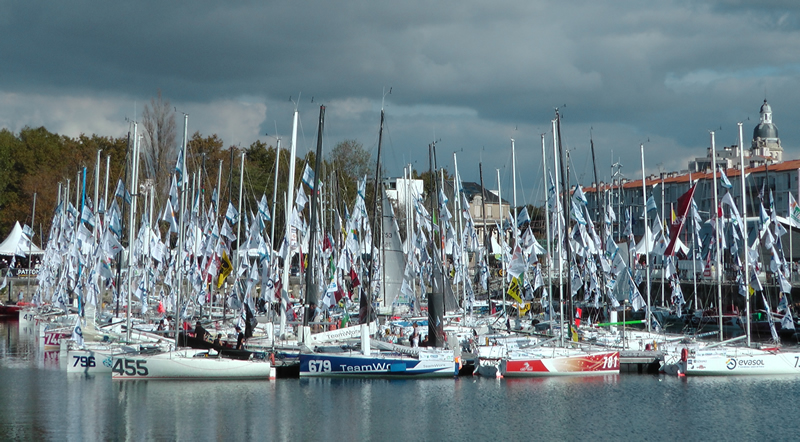
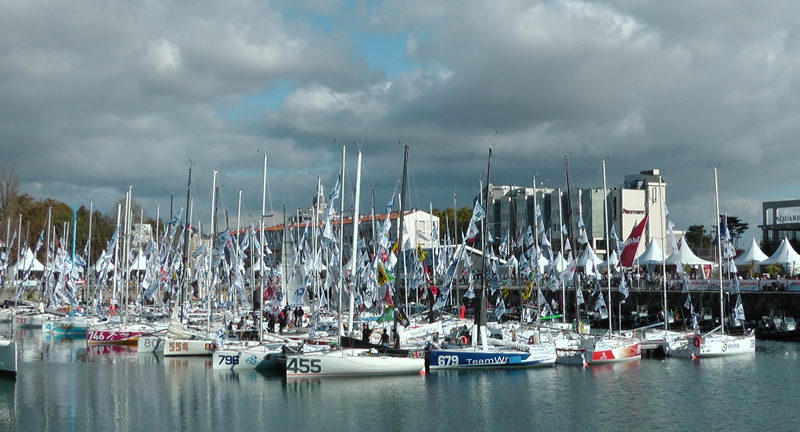
Charente Maritime-Bahia Transat 6.50 starts Sunday

The Charente Maritime-Bahia Transat 6.50 (Mini Transat) sets this sail Sunday from La Rochelle, bound once again for Salvador de Bahia, Brazil with a stopover in Funchal, Madeira.
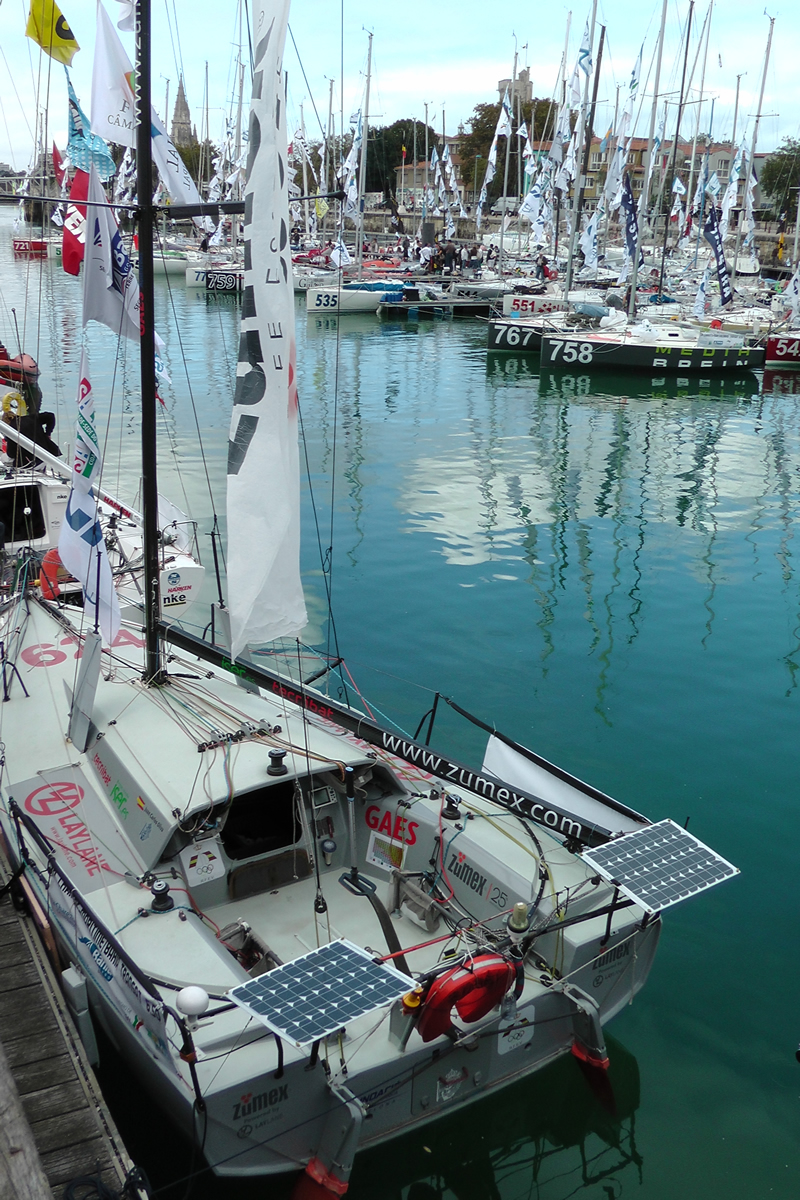
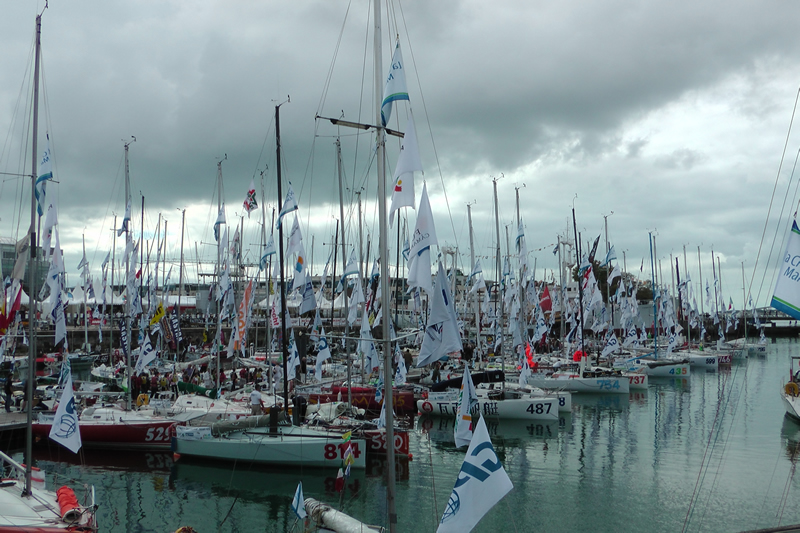
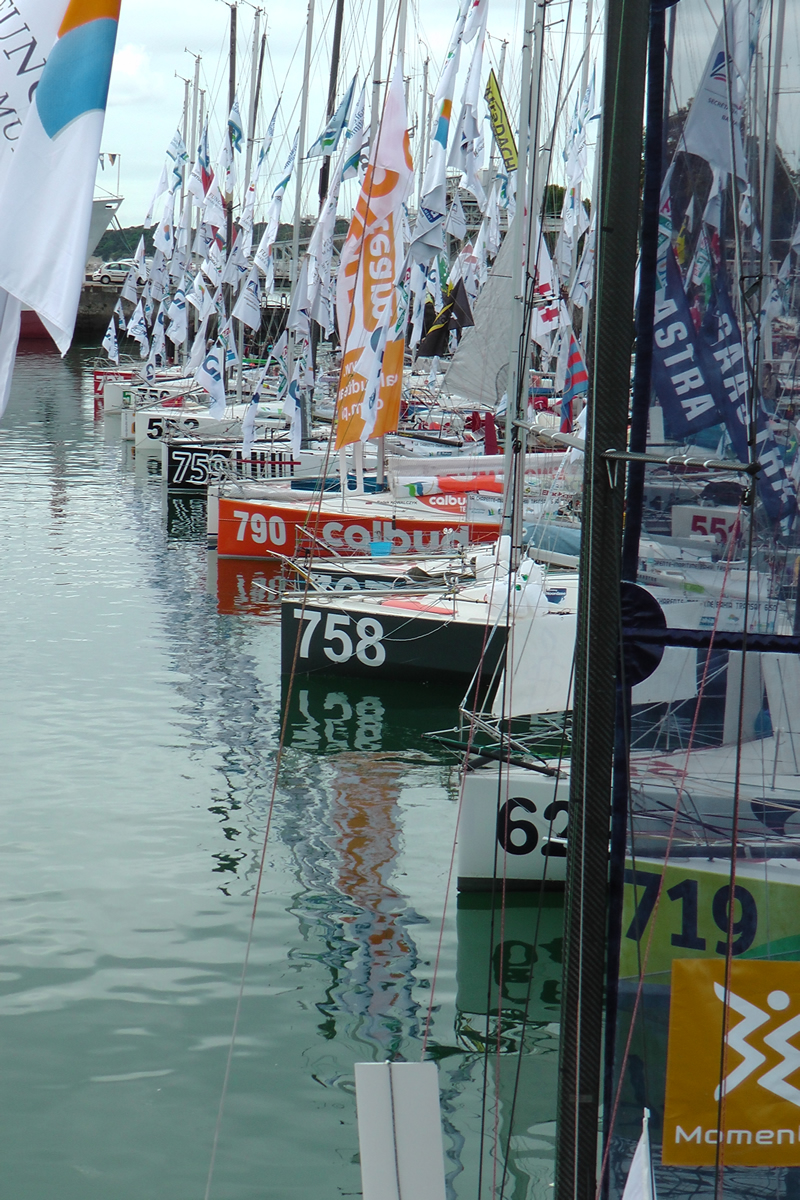
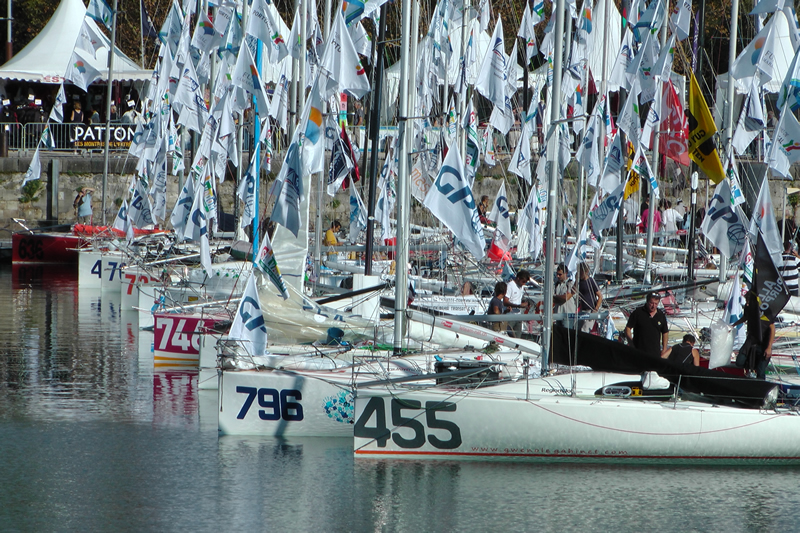
This year the race will feature 79 boats, as usual divided between the Proto and Series classes. The Protos are hi-tech one-offs while the Series boats are production boats (from a run of at least 10) built in glass, but which in recent years have been getting increasingly competitive.
This year’s Mini Transat will be 18th time the biennial event has been held since it was introduced by Bob Salmon as the more modestly priced antithesis to the 1976 OSTAR that included giants such as Alain Colas’ 236ft four master Club Mediterranée and Vendredi 13.
While the first four races ran from Penzance to Antigua via the Canaries, since 1985 the event has started from France. Many top ocean racing skippers have cut their teeth in this race from Jean-Luc van den Heede, Bruno Peyron and Halvard Mabire (setting sail this weekend in the Global Ocean Race) who all competed in the first event, to the likes of Yves Parlier (winner in 1985), Laurent Bourgnon, (second in 1987 ahead of Isabelle Autissier), Michel Desjoyeaux (winner of the second leg in 1991), Yvan Bourgnon (winner in 1991) Bernard Stamm (3rd in 1991), Thomas Coville, who was second in 1997, the same year as Mark Turner and Ellen MacArthur, plus Catherine Chabaud, Seb Josse and Lionel Lemonchoi – and a very very long list.
Minis are tiny, measuring just 6.5m LOA by 3m wide. However due to their compact size and relatively low cost compared to IMOCA 60s, they have traditionally been a hotbed of innovation. Probably the most significant development came in the 1991 race when Michel Desjoyeaux raced the first offshore boat ever fitted with a canting keel, which was subsequently adopted on Isabelle Autissier’s Open 60 Ecureuil Poitou Charentes, that won the first leg of the 1994-5 BOC Challenge by a country mile and the rest, as they say, is history.
The class has also been instrumental in the development of water ballast (first used on the 1979 race winner, American Express), twin rudders, the use of a bowsprit for gennakers and asymmetric spinnakers (although Mini bowsprits are unusual in that they articulate around the forestay attachment, so they fold within the perimeter of the deck for race starts, to comply with class rules – another Desjoyeaux innovation).
Where the Mini Transat is unique is in being a transatlantic race that features just the bear minimum of electronics – competitors cannot carry any comms equipment other than a VHF and an HF receiver (for receiving weather reports), nor a computer for emailling or carrying out weather routing. Only relatively recently have they been allowed to carry wind instruments... They genuinely sail for 4,200 miles, or roughly 30 days, entirely on their own with no outside contact. Electronics are limited to a log, GPS, an autopilot plus the new addition of an AIS transceiver or transmitter.
This year of the 79 boats taking part, 33 are competing in the Proto class, while 46 are Series boats.
The line-up is more international than ever with 35 non-French boats, from 17 countries including for the first time China, plus Germany, Australia, Belgium, Brazil, Canada, Spain, Italy, the Netherlands, Switzerland, Sweden, Czech Republic, Turkey, the USA, plus two – Pip Hare and Dan Dytch – from Great Britain (more on them in due course).
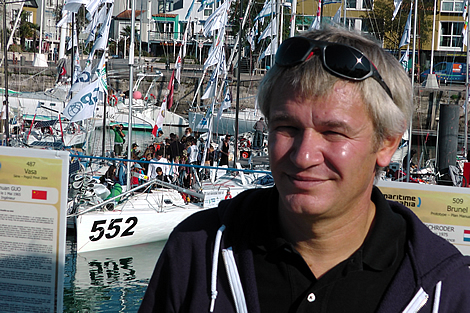
The Chinese competitor is Guo Chuan, who raced the last Volvo Ocean Race as media crewman on Green Dragon with skipper Ian Walker. “I came here to see the Mini Transat in 2007 and that was a fantastic memory for me,” Chuan told us. “I will try to achieve this, so it is a new beginning.” Obviously in doing the Mini Transat, Chuan is unable to compete in this year’s Volvo Ocean Race which features the event’s first fully Chinese-backed boat in Team Sanya.
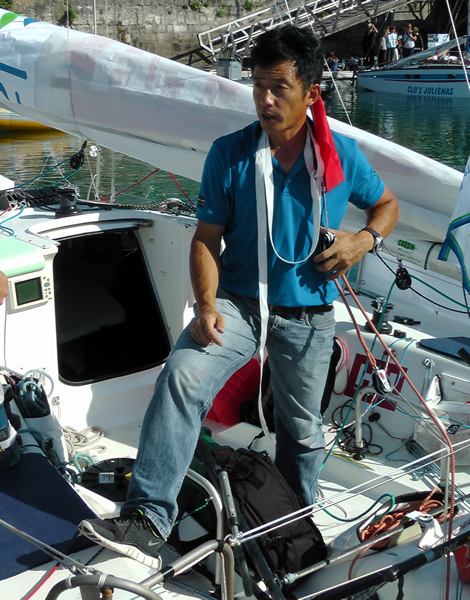
Chuan has been competing in the Mini class for two years and raced the Les Sables d’Olonne-Azores-Les Sables d’Olonne last year. His longer term plan is to be the first Chinese sailor to sail around the world singlehanded non-stop. He says he wants to set off from China next year on board an Akilaria Class 40 (which he has already bought and is now parked up in La Trinité). Chuan is already making a name for himself and teeming around him in La Rochelle have been numerous Chinese journalists armed with video cameras.
Compared to a class like the Figaro where the majority are repeat customers, only 15 of the 79 competitors in this year’s Mini Transat have done the race before.
Class President is Olivier Avram, who competed in the Mini Transat in 1999, 2005 and 2009. He says that little has changed in the mini rule but they continue to maintain the differences between the Proto and Series classes, the former to encourage design innovation, the latter as a more cost effective way into Mini racing. “So in Series carbon is allowed for the solar panel mount and the instrument displays, but otherwise it isn’t,” Avram says.
While at one point Protos represented the majority of the fleet and Series production boats were decidedly for ‘amateurs’, this has shifted in recent races with the Series class now dominant, offering stiff competition and attracting sailors more used to one design competition.
Avram says he wants to encourage more design development in the Protos class, like David Raison’s scow Proto (read more about this here) and Thomas Normand’s 2010 Manuard design Financiere de l’Echiquier, which has substantially more volume in her bow.
Avram says he is happy with the number of new Protos, but one problem is that the market for secondhand Protos seems to have stagnated. Having not sold his boat, originally Peter Laureyssens’ Ecover, a 2006 Finot design with a rotating canting wingmast (and sistership to Thomas Ruyant’s 2009 Proto winner), it is being sailed in the present Charente Maritime Bahia Transat 6.50 by former Classe Mini President Lucas Montagne.
During a brief stint in La Rochelle James Boyd carried out a minor poll on the cost of campaigns. Avram says that to build a new Proto costs in the order of 140-150,000 Euros, although we heard that campaign costs for a full-on two year Proto program, including a new build, can be up to 250,000 Euros. A cheaper option is buying a second hand Proto and something competitive can be obtained for 80-100,000 Euros, while older boats come in at 50,000. Avram points that a well-sailed 10 year old Proto is still capable of getting on the podium.
What is uncertain is the course for the 2013 Mini Transat. Every four years Classe Mini put the organisation and hosting of the race out to tender. While Avram won’t comment on who the contenders are – Brest, Douarnanez and Lorient have been rumoured as possibles, along with the possibility of the event’s start remaining in La Rochelle. The finish shifing back to the Caribbean, has also been mooted and this would represent a substantial shift, not only making the race shorter, but also eliminating the Doldrums/equator crossing. Avram points out that finishing in the Caribbean could be a problem since the season for tropical storms and hurricanes is starting earlier and earlier.
As ever the best stories from the Mini Transat are the individual competitors and this year is no exception. Aside from the largest number of international entries, among the fleet are some individuals such as Aurelien Ducroz who’s the 2009 and 2011 World Champion in Free-Ride skiing. This year’s race also features its first husband and wife, the Dutch couple Ysbrandt Endt and Christa Ten Brinke, who are both racing Rolland Dingo 2 designs in the Series class.